
Class Information
ENROLLMENT:
Classes are available to youth and adults. No experience is necessary to start.
Regular Membership – Allows a student access to all classes available on the schedule for their age group. Membership also allows for participation in regional events such as tournaments, training camps, as well as eligibility for rank examinations. Sign up at the studio.
Coventry Recreation – Offered 3 times per year, classes are 1 day per week for 8 – 10 weeks overlapping one of the regular membership classes. Check the schedule and register online at the town website. Navigate to ALL AGES PROGRAMS > KARATE.
All enrollments require a membership agreement to be filled out and signed prior to the first class. Download the membership agreement here:


CLASS SCHEDULE
TUITION AND FEES
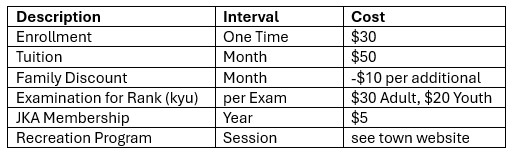
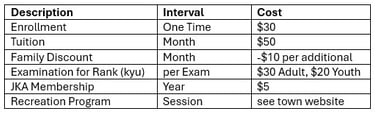
Acceptable forms of payment are cash or check
Free first class – Try a class for free. You will be asked to sign a form for insurance purposes, but there is no obligation to join.
ADDITIONAL INFORMATION
Uniform
A uniform (gi) is not required for beginners. Comfortable, modest gym clothes; sweatpants or similar and a tee shirt are acceptable (no shorts). Continuing students should buy a uniform. We can order for you or provide information for purchasing on your own. A plain white gi is required. Uniforms are typically light-weight for kids and medium-weight for beginner adults.
Class Structure
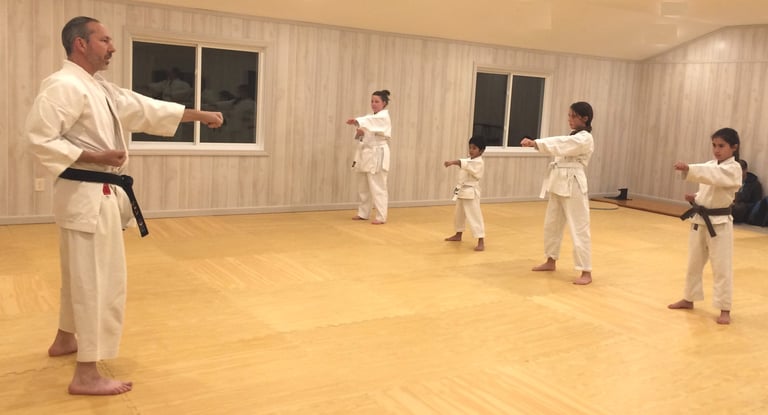
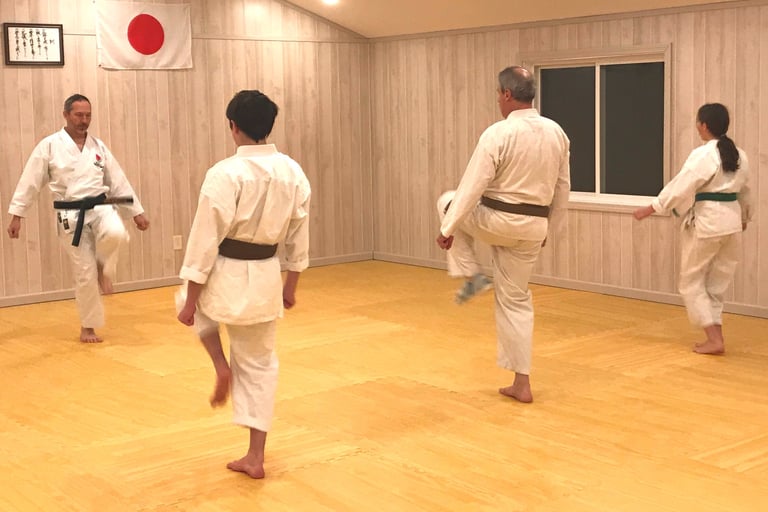
A typical class consists of three areas of practice.
Basics (kihon): Individual movements, combinations or other exercises that allow the student focus on fundamental elements of techniques such as blocks kicks and strikes.
Forms (kata): A pre-arranged sequence simulating multiple opponent scenarios. Many kata have been developed in many styles of karate. 26 kata make up the current standard of practice in JKA Shotokan. These kata vary in length and complexity to facilitate training at all skill levels emphasizing proper stance, posture and breathing.
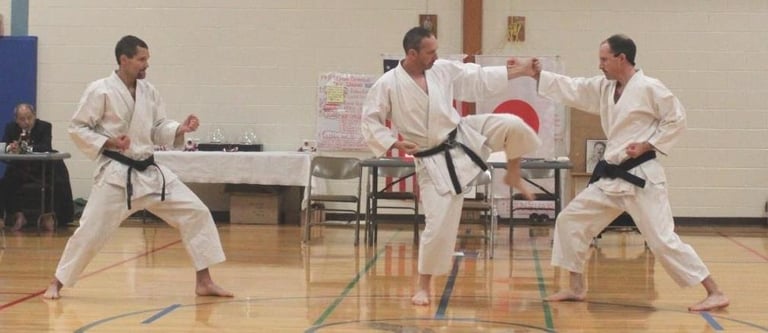
Sparring (kumite): Partner exercises that emphasize precision and control. Similar to kata, kumite is practiced at various levels. For basic levels, prescribed sequences are used allowing students to learn proper distance and course of motion. Advanced levels, such as free sparring develops timing, spontaneous reaction and creative strategies.
Class is conducted in the traditional Japanese format and students will be introduced to some Japanese terms throughout practice.
Logistics
Parking - Park anywhere on the property, including up by the house if the area near the studio is full.
Changing Room - There is a changing room on the first floor beneath the stairway.
Restroom – There is a restroom on the first floor at the end of the hallway. It is for everyone. Be respectful of others by keeping it clean.
Communication:
Email is the primary communication tool. We will use it to notify people of schedule changes, such as weather cancellations, and provide event information such as training camps and tournaments. Please make sure we have your preferred email address to receive these communications.
It is not necessary to email us if you will miss a few classes, but it would be helpful to know if you will be out for an extended period.
Dojo Etiquette
Safety
Keep your fingernails and toenails short.
Do not wear jewelry.
Do not chew gum.
Courtesy
Do not wear shoes on the training surface.
Always wear shoes if not in the upstairs studio area.Be on time. The dojo is open at least 15 minutes before class starts. Start to stretch and warm up on your own. If you are late, do not just walk into class. Sit (seiza) at the entrance to the practices area and wait for someone to admit you into class.
Keep your feet and uniform clean. Children may wear a plain white t-shirt under the uniform.
Bowing - Bowing is an important Japanese gesture. When entering and exiting the training area, bow to the front of the studio (shomen). Bow to your instructor and fellow students when you see them for the first time each day.
Do not leave class without warning or explanation. Raise your hand so your instructor knows what is happening.
Address your instructor as Sensei (pronounced “sen-say”).
Talking during class should be kept to a minimum.
Students must not use their karate skills in an offensive way outside of the dojo.
2026: All Rights Reserved